Key Takeaways:
Over half of Google searches now end without a click. Users get answers directly on the results page through AI Overviews, map packs, and review summaries, often without ever visiting your website.
Google is evaluating local businesses the same way it evaluates AI-generated content: Is this business genuinely the right answer for this searcher?
Four factors drive visibility in this environment: website content that shows real expertise, consistent information across directories and third-party sites, and a complete Google Business Profile (your listing on Google Search and Maps).
Reviews aren't optional. 87% of homeowners won't consider a business rated below 4 stars, and Google factors review volume, recency, and response rate directly into local rankings.
The goal isn't ranking #1 for one keyword. It's having AI recommend your brand as the top result when someone searches for your services.
More than 51% of Google searches now end without anyone clicking a single result. No website visit. No form fill. No phone call.
This isn't a bug. It's the direction search has been heading for years, and Google's rollout of AI Overviews has accelerated it. The question now isn't just How do I rank for certain keywords?, it's How do I become the brand AI recommends?
What AI Overviews mean for local service businesses
AI Overviews are Google's AI-generated summaries that appear at the top of certain search results. They pull content from multiple sources and give the searcher a synthesized answer, often before they scroll to any individual website.
For informational queries ("How long does a roof replacement take?" or "What is the typical penalty for a DUI?"), AI Overviews frequently answer the question entirely. The user doesn't click.
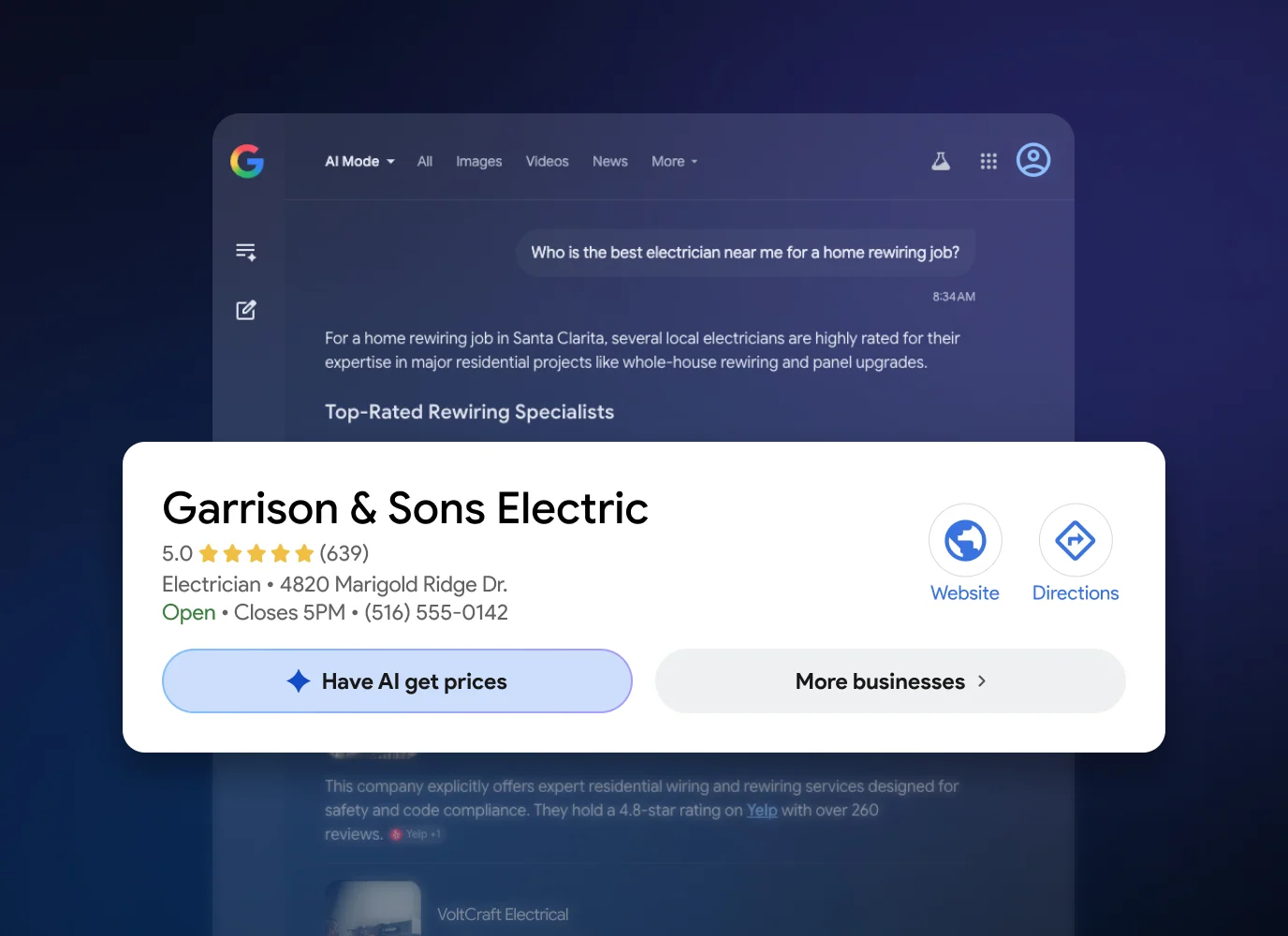
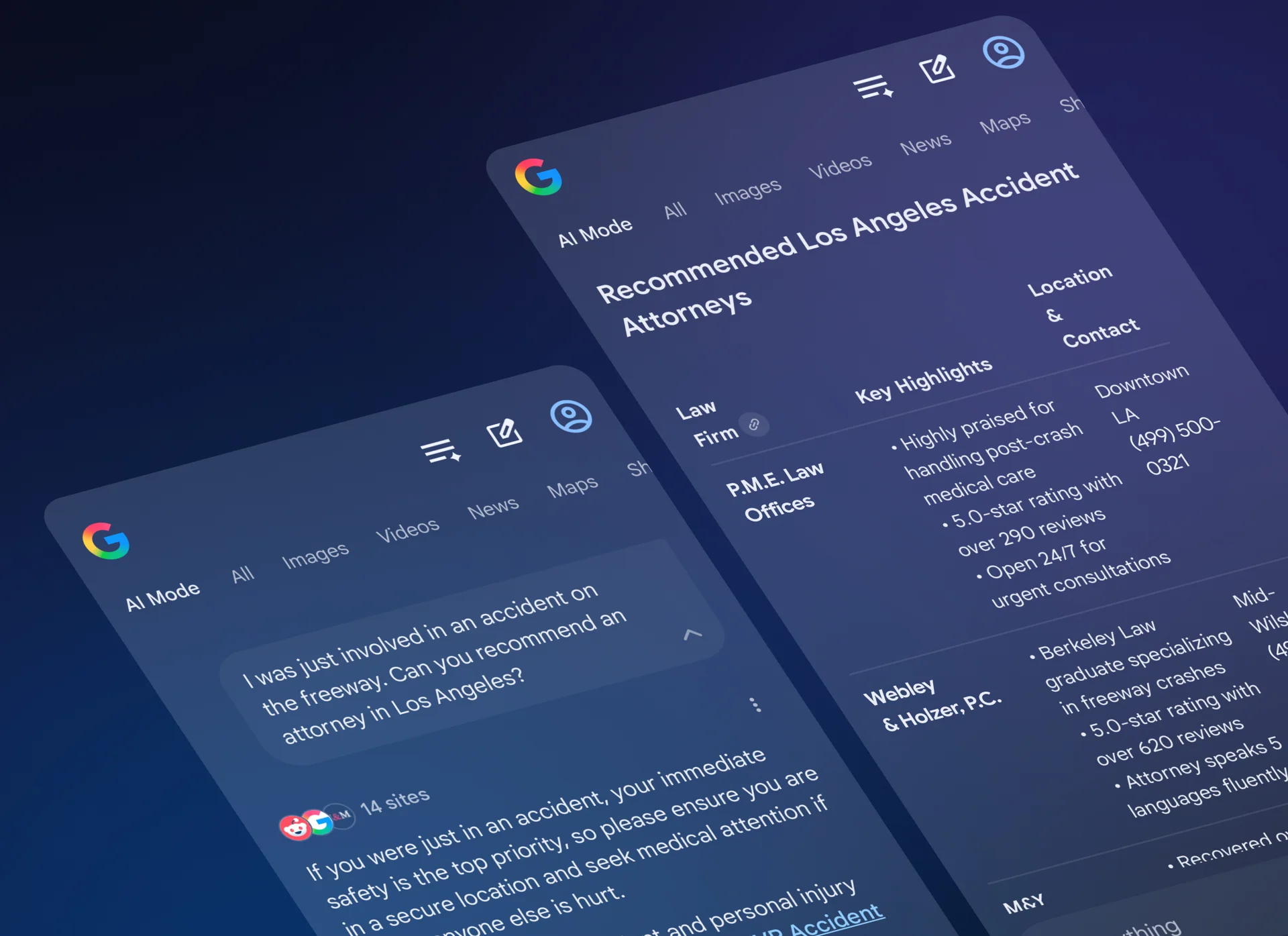
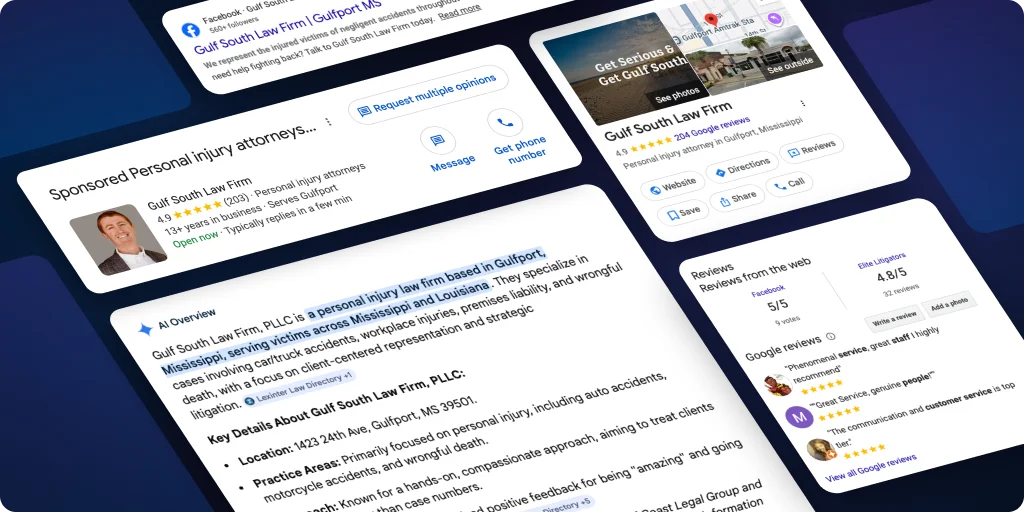
For transactional local queries ("roofing company near me" or "personal injury lawyer in [city]"), the dynamic is different. Google's local features (map packs, Google Business Profile listings, review summaries, click-to-call buttons) are still prominent, but the information Google pulls to populate those features is now evaluated through the same lens it uses for AI recommendations: Is this business genuinely the right answer for this searcher?
The businesses showing up in these features aren't getting there by accident. They've built the kind of digital presence Google trusts enough to surface with confidence.
Five factors that influence AI-driven local search visibility
Your website content and expertise signals: Your website needs to demonstrate that you're actually good at what you do. That means showcasing credentials and certifications, sharing specific information about your service area and what sets your business apart, and creating content that reflects your real expertise rather than templated copy aimed at hitting a keyword.
If your site only has location pages that read like "We provide [service] in [city]. Call us today for a free quote," those pages could be working against you. Google can increasingly identify a business that genuinely serves a community vs. a site that's structured to appear like it does.
Reviews and reputation: Reviews aren't just for winning over potential customers (although they matter there, too). They're a direct input into how Google evaluates and surfaces local businesses.
Volume matters. Recency matters. Sentiment matters. Whether your business responds to reviews, including critical ones, matters too.
Scorpion’s research on homeowner behavior shows 87% of homeowners won't consider a business rated below 4 stars. Google knows this, and uses your reviews to decide how visible you are in local search.A home services company with 300 reviews averaging 4.8 stars, including thoughtful responses to critical feedback, sends a much stronger signal than a competitor with 40 reviews at 4.8 stars and no engagement. The same is true for legal practices and healthcare providers. If your team isn't asking for reviews after every job, every appointment, every case closed, that's a gap to close now.
Third-party validation: Google doesn't evaluate your business in isolation. It looks at what the broader web says about you.
That includes:
Your digital PR: mentions in local news, community sites, and trade publications that reference your business in context.
Industry affiliations and certifications that carry authority in your vertical.
Consistent information about your business across directories, citation platforms, and listing sites. Inconsistency creates confusion and reduces trust.
A home services company listed with a recognized trade association, referenced in regional news, and consistently appearing across major directories is telling Google something important: this is a real, established business with a real presence in its community.
Google Business Profile: Your Google Business Profile is your most direct lever for local search visibility. It's also one of the most underused tools in most businesses' digital presence.
A well-maintained GBP includes:
Recent, high-quality photos of your team, your work, and your location
Accurate, complete service descriptions with genuine detail
Current hours, including any holiday or seasonal variations
Services and products populated with real specificity
Regular posts sharing updates, offers, or announcements
Active review management: getting new reviews and responding to them
Authentic video content: Written content can tell Google you're an expert. A video can show a potential customer why they should trust you.
A short owner introduction, a job walkthrough, or a straight answer to a question you hear every week ("Why would I want to settle a case instead of going to trial?") gives Google richer, more credible content to associate with your business. It also does something no service page can: it puts a real face and voice behind your name before anyone picks up the phone.
Upload it to your Google Business Profile, embed it on relevant service pages, and post it to YouTube (which Google owns and indexes heavily).
The businesses doing all of this consistently are giving Google exactly the kind of complete, trustworthy signal it needs to surface them, including in AI Overviews.
The search visibility playbook for 2026
The March 2026 Core Update is one event in a longer trend. Google is raising the bar on what it takes to be visible in search, partly in response to AI-generated content proliferating across the web, and partly in response to competition from search platforms built on large language models like ChatGPT, Perplexity, and Claude.
That pressure isn't going away. Here's a five-part approach to staying visible through what comes next:
Build a complete digital presence, not just a website. Your GBP, your third-party listings, your review profiles, and your social media activity all contribute to the signal Google uses to surface you. Treat them as part of a unified strategy.
Make your real expertise visible. Your website should show, not just claim, why you're the right choice for a searcher in your market. Authentic video explaining your expertise, credentials, news stories, certifications, service history, and community involvement all count.
Build review generation into your daily operations. A consistent flow of genuine, recent reviews is one of the most durable local search visibility strategies you can build. It has to become a standard part of how your team closes out every customer interaction.
Remove or replace thin content. Location pages, service pages, and about pages that say nothing specific about your business are liabilities. Replace them with content that reflects your actual work.
Think in terms of presence, not just position. The goal is to show up wherever your customer is looking: organic results, local pack, GBP card, AI Overviews, voice results. A business with presence across multiple search features is more resilient than one relying on a single organic ranking.
The takeaway
The businesses most at risk are the ones that built their online presence on shortcuts: templated pages, outdated profiles, and inconsistent reviews. The businesses that will hold up are the ones that invest in authentic content, a genuine reputation, and a complete, well-maintained digital presence.
If you're not sure where your business stands heading into this next chapter of search, that's exactly what Scorpion is here to work through with you.
Talk to our team about your local search visibility strategy!